Overview
Across Africa and parts of Asia, millions of young people want to learn coding skills but lack the basic tools most platforms assume: a laptop, reliable broadband and instruction in a first language they truly understand. Meanwhile, smartphone ownership is widespread, and often the only available device, yet those devices are rarely designed as serious learning tools.
Chidi Nwaogu, Co-founder and CTO of Efiwe, is changing that. Together with Co-founder and CEO Abhinav Negi, he created Efiwe, a mobile-first coding platform built to run on low-cost smartphones, including devices with as little as 1GB RAM. It allows learners to practice web development with AI support even when connectivity is unstable or unaffordable.
Launched in August 2025, the platform has already reached nearly 9,000 users across 121 countries. Early pilots in Nigeria and India recorded a 100% week-one completion rate, challenging industry norms and proving that inclusive, mobile-native learning can work at scale.
The challenge
Access to digital skills in emerging markets is shaped by infrastructure, income and language. Many coding platforms are designed for desktop users with stable broadband, yet in large parts of Africa and Asia, a smartphone is often the only device available. Connectivity may be intermittent or too expensive to sustain streaming-based learning.
Chidi encountered this gap firsthand in 2024 while working as Academy Director for a Netherlands-based ed-tech company expanding across Africa. More than half of applicants could not enrol because they did not own laptops. Those who joined often dropped out of virtual classes due to unstable internet connections. He also realised that while many learners speak some English, very few think in it as a first language, creating an additional cognitive barrier to technical learning.
The result is a system that unintentionally excludes those who need it most. Digital skills are increasingly linked to employment and economic mobility, yet existing training models often reinforce inequality rather than reduce it.

If my product is exactly the same at the end of the programme as it is now, then I’ve done something wrong. I want fresh eyes on it. I want people pushing me to improve it.
The innovation
Chidi wanted to redesign coding education around the realities of digital education in many parts of Africa and Asia.
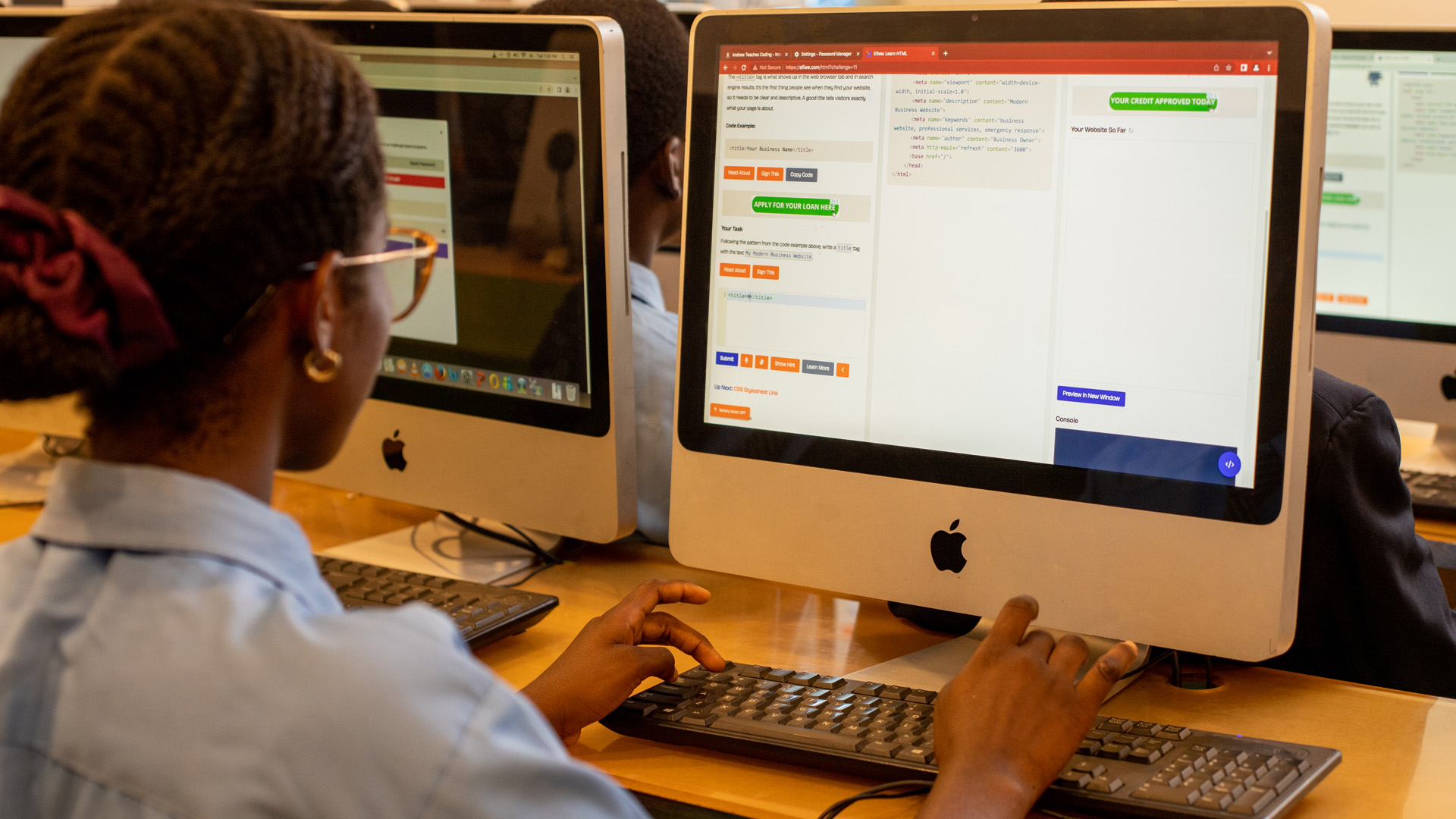
Efiwe transforms smartphones into fully functioning coding classrooms. Rather than adapting a desktop product for mobile, the platform has been built mobile-first, then extended to desktop. Learners build real websites step-by-step using HTML, CSS and JavaScript through short, interactive challenges that typically take around three minutes each to complete.
At its core is a dual AI architecture. Efiwe 1.0 runs lightweight TensorFlow.js models directly in the mobile browser, enabling instant feedback without an internet connection. When connectivity is stable, Efiwe 2.0 activates a more robust cloud-based model built on established language models such as Google and Meta systems. If connectivity drops or demand spikes, the platform automatically falls back to the offline model, ensuring continuity.
All learner progress is stored locally in the browser and synchronised automatically when the user reconnects. Voice-based guidance, available in 189 languages including major African languages such as Yoruba, Igbo and Swahili, allows instructions and feedback to be read aloud with highlighted text for accessibility.
Efiwe is built to be inclusive by default as it operates on a freemium model. Core learning remains free to access, while optional purchases include QR-code verifiable certificates and additional “lives” within the gamified system. Schools and NGOs can create group accounts to onboard learners and track progress.
The company is led by Chidi as CTO and Abhinav Negi, Co-founder and CEO, who joined after experiencing similar barriers in India. Two additional team members support animation and design.
Video transcript
I started learning how to code when I was 13, and by the age of 17, I had learned how to code in over seven languages. And by when I finished university, I had sold my first startup and I believe that this was the life I was created to do.
Efiwe is a mobile first AI-driven platform. So that means you get to learn on your mobile phone using interactive gamified challenges, that feels more like you're playing a game rather than sitting in the classroom. And you don't have to worry about the internet, so you can even learn how to code on your commute.
Winning the Africa Prize will mean validation. It will inspire my team to keep working harder on what we are doing. It will give us that renewed energy to keep pushing harder every single day.
The impact
Efiwe removes one of the most persistent barriers to learning to code: access. For learners with only a basic smartphone, it offers structured practise, AI feedback, and the ability to progress even when connectivity is limited. The platform works on any smartphone, Android or iOS, including older and entry-level devices, and does not require an app download. Learners simply visit efiwe.com in their mobile browser to begin coding.
Within months of launch, the platform reached nearly 9,000 users across 121 countries through organic growth alone. Users spend an average of 27 minutes per day learning, with roughly one third returning daily. Early pilots in schools across Nigeria and India showed a 100% week-one completion rate among the first 100 users, significantly outperforming typical industry benchmarks.
Efiwe has begun working with schools and public institutions, tailoring pricing to local realities. The team is now focused on strengthening certificate recognition and building partnerships with employers to connect top learners to micro-internships and real-world experience.
As a shortlisted entrepreneur for the Africa Prize for Engineering Innovation, Chidi hopes the programme will accelerate product evolution rather than validate the status quo.