Overview
Across sub-Saharan Africa, unreliable electricity and oxygen shortages can turn routine hospital care into a life-or-death gamble, particularly for mothers, newborns and older patients. In Nigeria, many facilities rely on diesel generators for power and source oxygen from distant plants, leaving services exposed to fuel shortages, cashflow gaps and delayed deliveries.
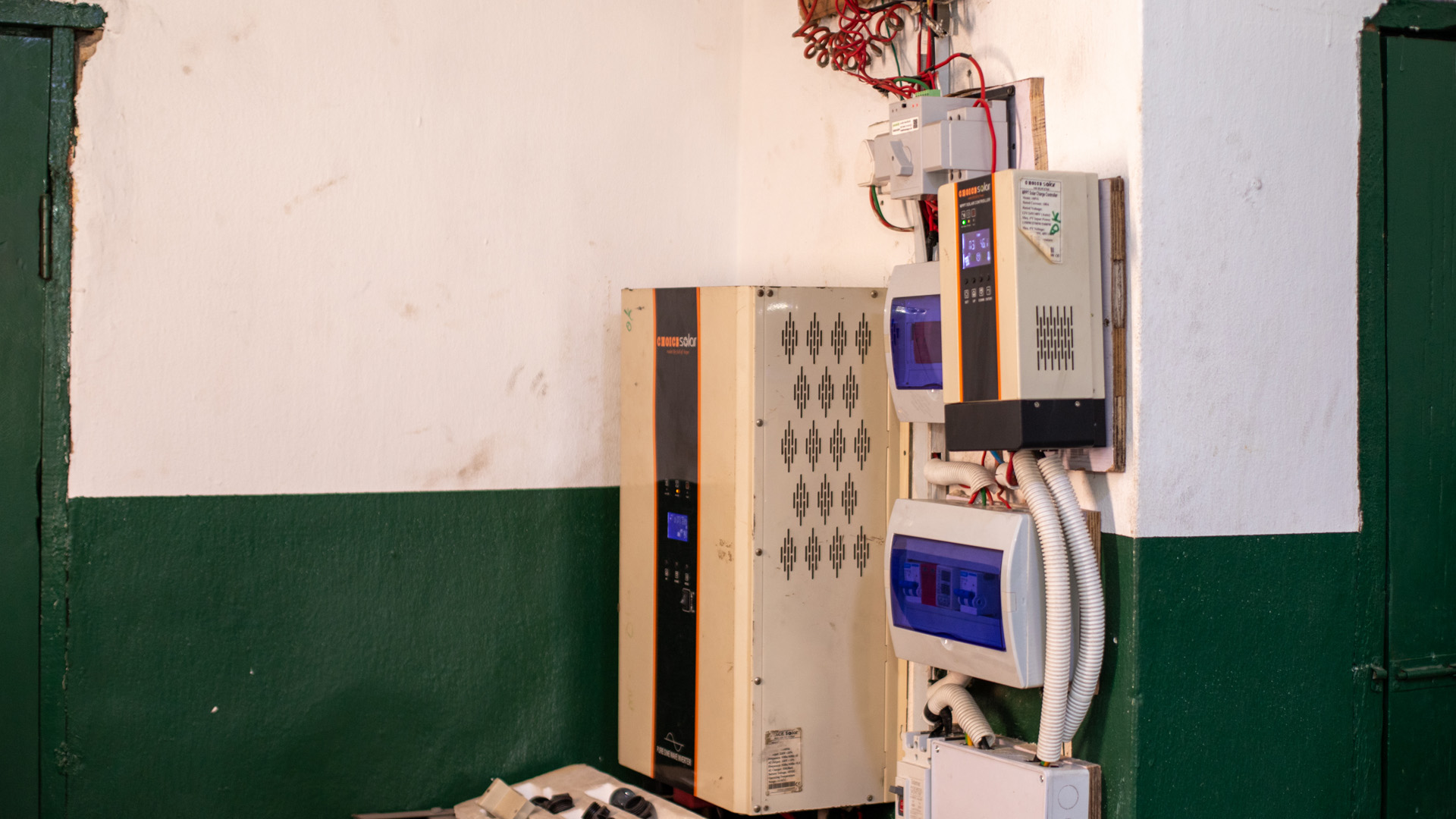
Derick Nwasor and his co-founder, Joy Egbe, developed the innovation Just Add Water to address these issues with an on-site solution that produces electricity and oxygen from water and is powered by solar energy and a regenerative hydrogen fuel cell system. Instead of selling equipment outright, energy and oxygen is provided as a service, so hospitals can adopt the system without a significant upfront investment. Deployed in three hospitals in Lagos so far, the system has already generated clean electricity and produced medical-grade oxygen directly where it is needed, cutting diesel reliance and helping clinicians deliver more consistent emergency care.
The challenge
Derick was born and raised in Nigeria, where power cuts are a part of daily life, and that experience shaped his focus on energy poverty. For hospitals, unreliable power brings significant risk: it can interrupt critical care and compromise emergency procedures, prevent equipment from being used safely, and undermine the safe storage and delivery of oxygen. Many facilities still depend on diesel generators that are expensive to run and vulnerable to disruption when fuel is scarce or budgets tighten. Oxygen supply is often equally fragile. Where oxygen is produced off-site and trucked in from remote plants, delays and shortages can quickly become dangerous, especially during obstetric emergencies and acute respiratory cases.
Derick’s motivation became more personal when he was admitted to hospital and nearly lost his life because doctors could not provide enough consistent power and oxygen to support his care. That experience pushed him from academic interest into entrepreneurship, with a clear goal: to build advanced energy technology that can be deployed quickly and realistically in Nigerian conditions.

In a hospital, power and oxygen are not ‘nice to have’, they decide who lives. Just Add Water exists so doctors can focus on care, not diesel, and so hospitals can keep lights on and oxygen flowing when it matters most.
The innovation
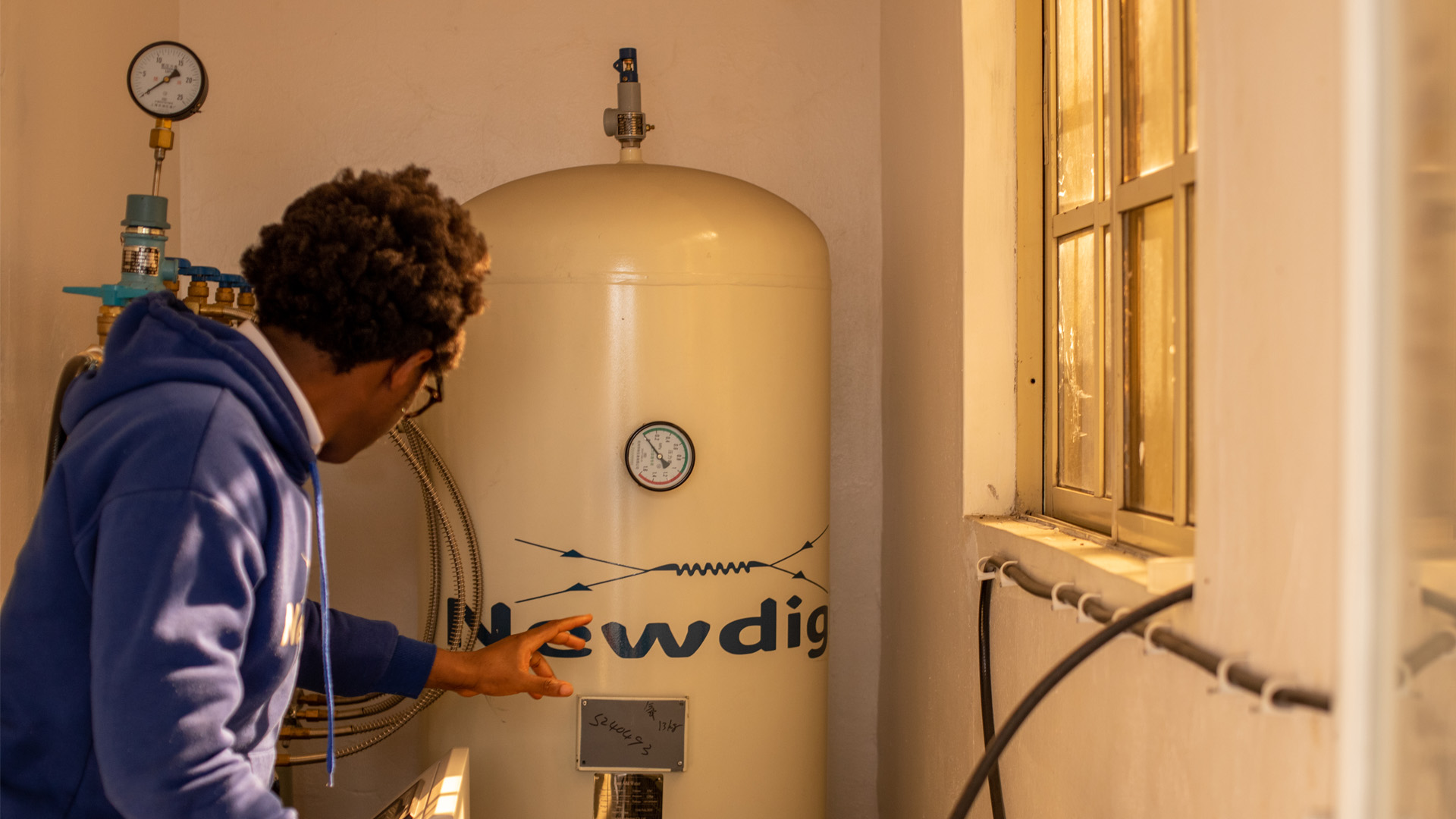
Derick is the co-founder and CEO of Newdigit, and he describes himself as a deep tech entrepreneur with a physics background. Just Add Water is designed as an integrated, on-site hospital utility. At its core is a regenerative fuel cell system that can operate as both an electrolyser and a fuel cell in one unit. The system uses electricity from solar panels to split water into hydrogen and oxygen. The oxygen is captured for hospital use, while the hydrogen is then used to generate electricity when solar supply is low, helping support round-the-clock operation without relying on diesel as the default backup.
Most existing technologies use either a fuel cell or an electrolyser, which are expensive, sold separately, and rely heavily on rare metal catalysts and ultra-pure water to drive the reaction that splits water. Just Add Water combines both functions into one system, generating 15 kilowatts to 1 megawatt of electricity alongside 40 to 1,000 litres of medical grade oxygen.
Just Add Water uses iron nanoparticle catalysts and a quantum process called chiral-induced spin selectivity to enable the system to use less expensive materials. This helps to make the system more affordable and practical for hospitals operating in resource-constrained environments. An artificial intelligence system monitors and manages the proton exchange membrane (PEM) - the component that separates hydrogen and oxygen within the cell – reducing maintenance demands.
The system is designed to work with ordinary tap water rather than requiring ultra-pure inputs, which is important in real hospital environments where controlling water quality can be a barrier to day-to-day reliability.
Video transcript
When I was admitted to hospital I nearly lost my life due to power oxygen related failure. A typical problem that exists across 40,000 hospitals in Nigeria. In order to solve this problem, engineering was the way. Our solution is called Just Add Water. It's a quantum regenerative fuel cell that converts ordinary water into hydrogen and oxygen, electrifying healthcare and providing each patient with medical oxygen on sites.
Winning the Africa Prize is going to be a game changer for us, because we have currently demonstrated our solution from laboratory to pilot deployment. Therefore, this is what we need to enter the next phase. Winning the Prize comes in at the right time for us to expand our three deployments to addition of five more deployments, covering an entire Sangotedo community, providing them with 24/7 electricity and medical oxygen on site, unlike what they currently have before.
The impact
Just Add Water is already deployed in three hospitals in Lagos. Those installations have generated more than100 MWh of clean electricity and produced 17,800 litres of medical-grade oxygen, supporting care for more than 11,100 patients. Hospitals have reported major operational benefits, including in some cases, a full reduction in diesel dependence, reductions in operating costs, and the confidence that oxygen and electricity are available during emergencies. The system is also a more sustainable alternative to diesel, with current estimated annual emissions reductions of more than 77,000 kg of CO₂.
Derick explained that one of the biggest barriers is space: solar panels can be installed on roofs, but the oxygen and hydrogen components need dedicated internal space, which hospitals often lack. To address this, the next phase is to develop a compact version that can be delivered as a self-contained unit, avoiding the need for hospitals to build new rooms from scratch and enabling faster installation. The team is also developing technical improvements, such as thermal and water management to increase efficiency, using early deployments to gather the operational data needed to expand safely and meet regulatory requirements.