Overview
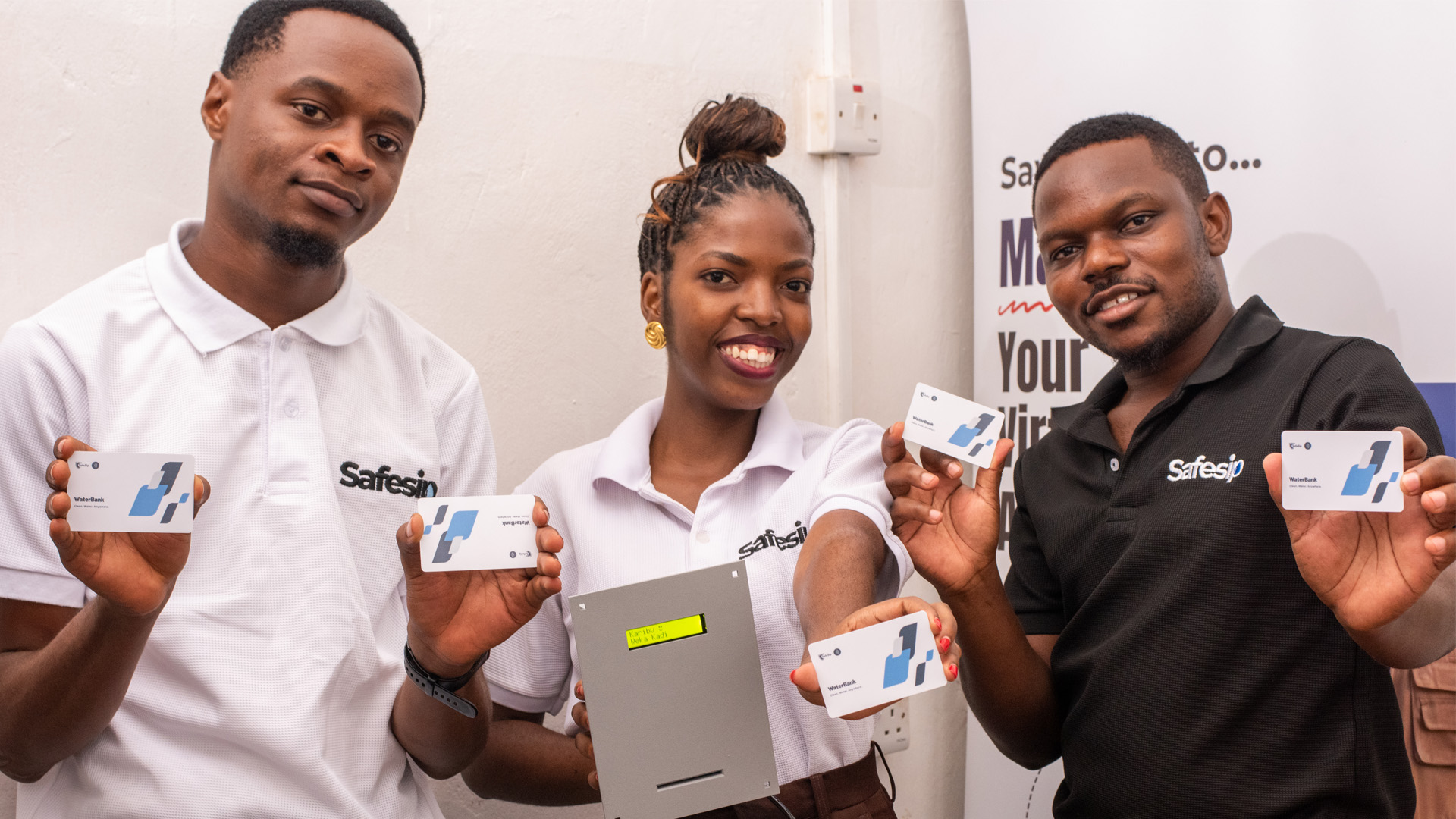
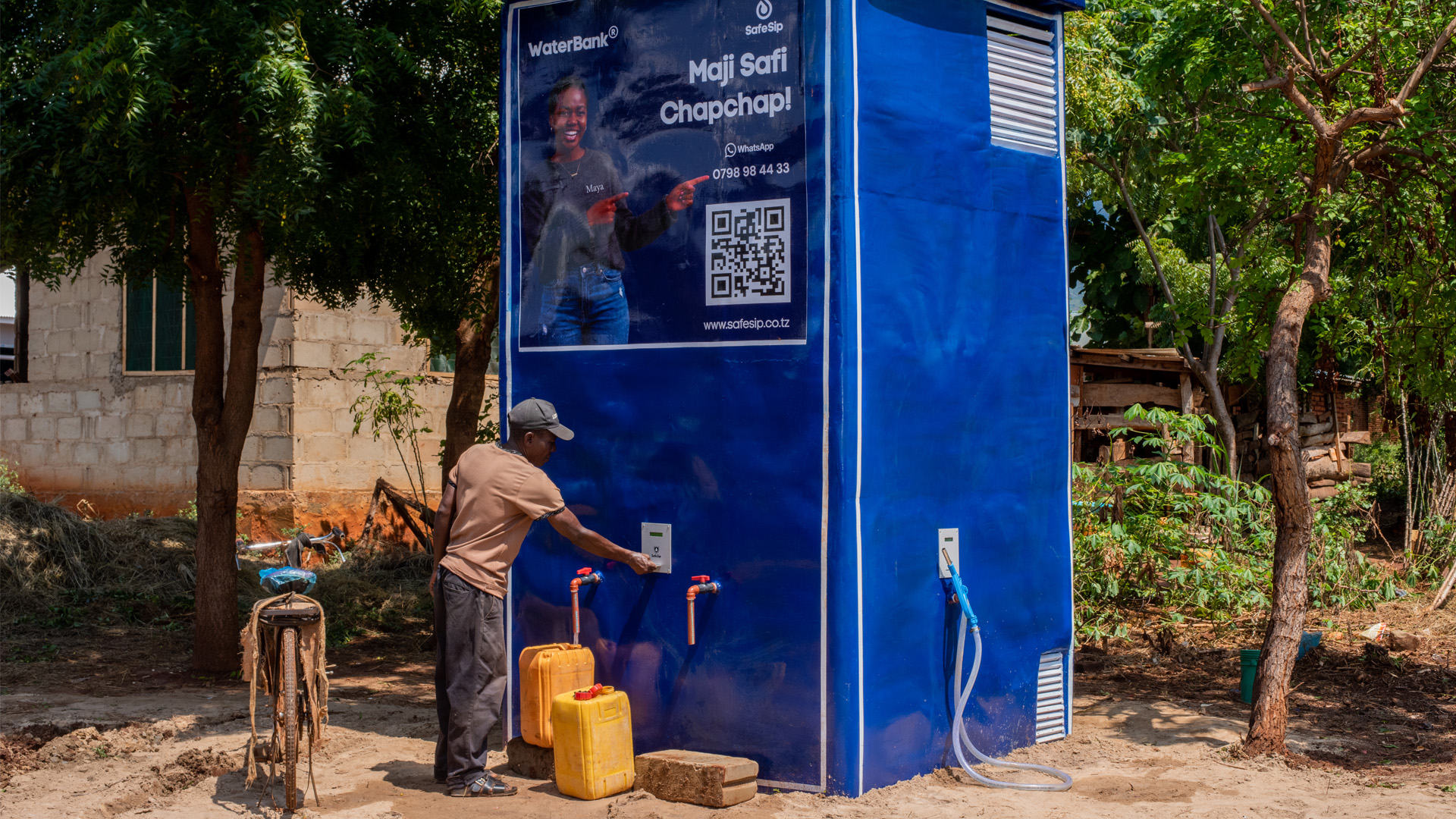
Families in rural and peri-urban Tanzania often depend on rivers, boreholes or informal kiosks for drinking water, where the quality is unsafe and supply is unreliable, with women and children carrying much of the daily burden. WaterBank tackles that gap in supply with a new kind of local utility: an off-grid, solar-powered system that treats water on site, monitors itself using AI to reduce operational downtime due to maintenance issues, and has the ability to dispense water 24/7 through prepaid radio frequency identification (RFID) cards, with optional doorstep delivery via micro-tankers.
Built by Faith Kuya, CEO of SafeSip, with co-founders Costantine Edward, Samwel Mdenye, and Ella Evrahim, WaterBank is designed to be commercially viable where traditional kiosks frequently fail. Four operational units are now active in Tanzania and serve more than 6,000 users each month. Communities report significant reductions in waterborne illnesses, high rates of repeat usage and informative recommendations to manage water consumption.
The challenge
In many parts of Tanzania, access to water does not mean access to safe water. River water and poorly treated boreholes can be contaminated, and even where kiosks exist, they often break down within months because maintenance is inconsistent and revenue collection is weak. In semi-arid areas, salinity adds another barrier; deep boreholes can produce water that is undrinkable without proper treatment.
Faith grew up in a community with no reliable water supply, where people relied on rivers and boreholes despite health risks. While studying environmental engineering and later working in municipal water services and water quality roles, she kept returning to the same question: what would “water systems 2.0” look like if they could run reliably without constant on-site oversight? WaterBank began as her university capstone project and then evolved through field experience into a deployable product.
Being shortlisted for the Africa Prize means a great deal to me. I hope to gain mentorship on design for manufacturing, thermal management and optimising our internal layouts for durable mass production, so we can scale WaterBank safely and sustainably.
The innovation
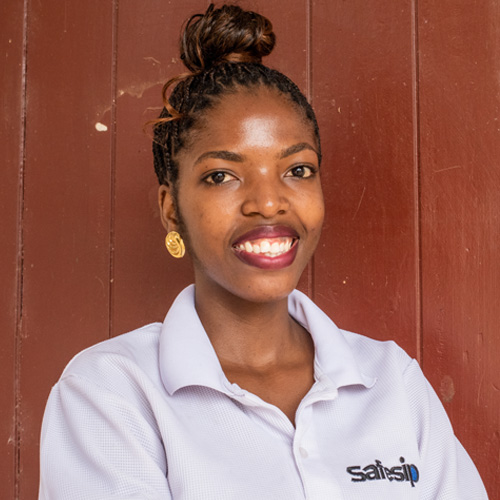
Faith Kuya is the CEO and co-founder of SafeSip, the venture behind WaterBank. The WaterBank innovation combines advanced water treatment, remote monitoring and AI, and inclusive payment to support reliable safe water access using minimal infrastructure.
WaterBank is a fully autonomous, solar-powered water utility built for off-grid environments. It treats water at the point of dispensing, using a four-stage filtration process that includes a kidney inspired 0.01-micron membrane, removing 99.99% of bacteria and pathogens from the supply. In areas where borehole water has high salinity, the system also desalinates water to make it safe for consumption.
To reduce breakdowns, WaterBank uses an AI-powered monitoring system that continuously tracks indicators such as pressure and flow. By detecting anomalies early, it can flag potential clogging or component failures and send alerts so that local technicians can intervene quickly. The team describes this process as “install and forget” because it aims to prevent small faults from leading to long periods of operational downtime. Maintenance is typically completed within two to three hours once an alert is received.
The utility runs on 100% solar power, supported by high-capacity lithium batteries that store sufficient energy to continue running during low-sun periods. The model is deliberately designed with no need for on-site operators and customers access the water using prepaid RFID cards rather than cash. This approach reduces theft risk and cash handling and makes it easier for children to collect water safely without carrying money. Users can top up via mobile money, and water is priced at around $0.04 per 20 litres, positioning it as an affordable alternative to bottled water.
WaterBank can also operate a hub-and-spoke model using branded micro-tankers to deliver water to households further away, extending its reach while acting as visible mobile promotion within communities. Most components are assembled locally in Tanzania, with some specialised membranes imported.
Video transcript
I was inspired to become an engineer because I wanted to eliminate water poverty — the daily struggle for water that mostly affects women and children in communities. During my environmental engineering degree and my work at WaterAid, I saw that scalable engineering could transform off‑grid communities.
Our innovation, WaterBank, is a fully autonomous solar‑powered water utility. It uses an advanced 0.01‑micron filtration membrane, AI predictive maintenance, and an inclusive cashless system, so it delivers safe water 24/7 without on‑site staff.
Each WaterBank has youth‑operated two‑tonne motorised micro‑tankers, coordinated by our AI agent Maya in WhatsApp, allowing us to reach more than 80% of customers who cannot reach the WaterBanks directly.
Winning the Africa Prize would give us inclusive design for manufacturing and thermal management mentorship for our version‑two hardware, plus financial model support to scale across East Africa.
The impact
WaterBank has four operational units serving 6,000+ users each month. The team reports reductions in waterborne disease by more than 30% in communities served, with local surveys indicating a 43% reduction in diarrhoea cases. Adoption indicators are also strong, including 76% retention and 84% of users recommending the service.
Beyond health, reliable water access is enhancing local livelihoods, such as new small businesses like car washing services in areas that previously lacked dependable supplies of water. Faith also highlights unexpected social impact: many customers value owning the RFID card as a form of financial inclusion, with some taking special care to protect it.
Since launch, the company has grown from six to twelve employees and secured more than $150,000 in grant funding and seed investment, alongside multiple awards and recognitions.