Overview
Across sub-Saharan Africa, more than 600 million people live without reliable electricity, leaving clinics, schools, and households vulnerable to daily blackouts. In Ghana, many rural health centres depend on expensive, polluting and noisy diesel generators that limit services and strain budgets.
To address this gap, engineer Johannes Amo-Aye created MINAGIE Energy’s Fusion Wind Turbine, a hybrid wind and solar microgrid system designed for off-grid and underserved communities. Working alongside his co-founder and public health expert Elizabeth Onireti, the team ensured the technology was not only engineered for performance but also aligned with the real needs of frontline health workers and communities.
Together, they set out to address three persistent challenges: unreliable electricity in rural health centres and schools, high reliance on costly diesel generators, and limited local technical capacity to maintain energy systems.
Engineered for low noise and high reliability, the Fusion Wind Turbine provides continuous clean power for critical services, enabling safe night-time care, dependable vaccine refrigeration and improved patient outcomes. Early installations in Ghana have already replaced diesel generators, saving around $500 per month in fuel costs while delivering reliable lighting and refrigeration for surrounding communities.

When I found out I was a finalist my heart was beating. I was happy, grateful. It felt like validation of a childhood dream, that an African solution can solve African problems.
The challenge
For many communities in Ghana, power cuts are a routine part of life, but the consequences can be life-threatening if, for example, a clinic does not have sufficient light to examine and treat patients, keep vaccines and medicines refrigerated, or operate vital equipment.
The default backup option is usually diesel, but diesel generators are expensive to run, difficult to maintain, and loud enough to be disruptive in health settings. They also lock communities into fuel costs and supply chains that can change overnight. Even when solar is available, solar-only systems can struggle during long cloudy periods, and battery systems can fail if they are not maintained properly. The wider challenge is finding an energy solution that is reliable, affordable over time, and practical for remote areas where technical support is limited.
The innovation
Growing up in an Accra suburb, where power cuts were common, Johannes wanted to find a sustainable and cost-effective alternative to diesel generators. He developed the Fusion Wind Turbine to deliver steady decentralised off-grid electricity by combining wind and solar power generation into one hybrid system, built around low-maintenance engineering and a community-led deployment model.
At the heart of the system is a Darrieus H-type vertical-axis wind turbine paired with a solar arch. The turbine uses twin gearless, direct drive wind energy generator that operates with magnetic levitation (MAGLEV modules), eliminating internal friction during operation. By removing the gears and mechanical contact, the turbine runs more efficiently, produces extremely low noise and requires significantly less maintenance than conventional small wind systems.
Above the turbine sits a solar arc fitted with bifacial panels oriented to trace the sun’s path across the sky, helping provide consistent power from sunrise to sunset. Around 90% of the Fusion Wind Turbine’s components are designed and manufactured in Ghana. Only a few specialised elements, including the rare earth magnets for the MAGLEV rotor system, the weather station and hybrid wind-solar controllers, are imported.
The system operates without lubricants or oil, reducing upkeep in harsh environments. Operation and maintenance costs are minimal, requiring periodic system checks and routine cleaning of the solar panels.
Video transcript
I grew up in South Labadi, one of the suburbs in Accra, Ghana that struggled with energy poverty, and I wanted to use engineering to design solutions that would directly improve lives. Such that children today will not endure or experience the discomfort that I experienced growing up.
The Fusion Wind Turbine is a locally manufactured hybrid system that combines wind energy and solar into one recyclable, reusable, lubricant‑free unit. With the adoption of magnetic levitation technology and its twin permanent magnet synchronous generators, coupled with its IoT systems, it delivers clean, reliable, affordable electricity to underserved communities in sub‑Saharan Africa with minimal maintenance.
Winning the Africa Prize will validate our innovation on a continental stage. It will open doors for us to scale across Africa and accelerate our mission to provide clean, affordable, reliable electricity to underserved communities in sub‑Saharan Africa.
The impact
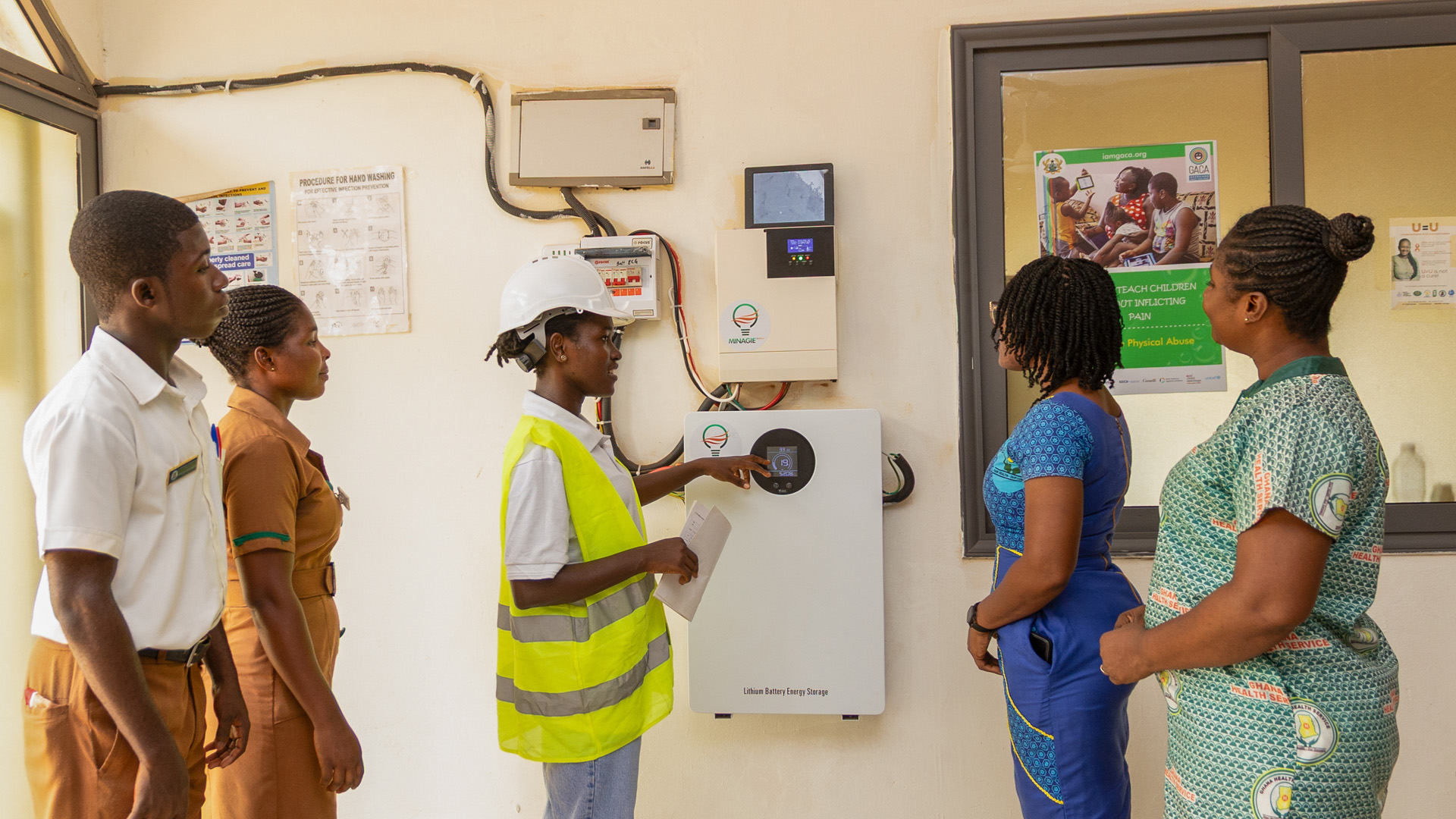
MINAGIE Energy works through established relationships with and Ghana’s Ministry of Health and other partners to identify sites and build trust. To date, the Fusion Wind Turbine has been deployed at two remote, rural health centres in the eastern region of Ghana, with two Fusion Wind Turbines installed and around 850 people within the catchment areas served by those facilities. In addition to the Africa Prize, their work has also been supported by UNICEF Ghana’s, UNICEF Scale-Up Fund
Johannes has witnessed the difference that reliable power can make in a rural clinic, sharing a moment in 2024 when a midwife had to deliver a baby during a community-wide blackout using only phone torches. In the poor lighting, warning signs were missed, he says, and tragically the baby died. The same mother returned recently to give birth again, in a well-lit ward with functioning equipment running. The improved conditions greatly assisted a successful birth this time.
MINAGIE’s next focus is scaling. The team plans to deploy 25 turbines across rural Ghana in 2026 and train 25 technicians, expanding to 60 turbines and five hubs in 2027, and reaching more than 100 turbines and ten hubs by 2028, as well as launching carbon credit monetisation. Johannes says affordability remains one of the biggest barriers, as hardware costs are high and customers need support to transition away from diesel.