Overview
Across sub-Saharan Africa, more than 230 million people face food insecurity, while smallholder farmers, who produce up to 80% of the region’s food, face water scarcity, soil erosion, weeds, climate shocks and limited market access. In Lesotho, the challenge is intensified by heavy reliance on imported vegetables, creating both a vulnerability and an opportunity for local production to scale.
Farmflex is a smart farming platform that combines protected agriculture, aquaponics, real-time sensor monitoring and AI-driven analytics to help farmers increase yields and reduce losses while improving predictability. Offering digital traceability and market tools, the platform helps farmers to meet buyer standards, forecast harvests and supply more reliably. The system has already served more than 160 clients through Lesponix Collective, including agribusinesses and a cross-border installation in Eswatini, with farmers reporting higher yields and stronger revenues as quality and consistency improve over time.
The challenge
In Lesotho, many farmers are constrained by limited arable land, unreliable water supply and increasing climate volatility. Even when production improves, smallholders often struggle to sell into commercial channels that require consistent quality, traceability and accurate forecasts.
Hydroponics and aquaponics are solutions that can solve land and water constraints, but they create a new pressure: coordination at scale. Without reliable data on growing conditions and likely harvest volumes, farmers cannot confidently meet delivery schedules or negotiate with buyers, and manual monitoring is prone to human error and gaps in support.

The Africa Prize is an opportunity to be build credibility required for us to penetrate the Southern African market. We’re tackling a lot of pain points for farmers, so we’re really looking forward to getting insight on how to streamline our services and tap into European think tank.
The innovation
Mochesane Mpali, Founder and CEO of Lema Agriventures Pty Ltd, created Farmflex after seeing how quickly manual monitoring and inconsistent standards became a barrier as more farmers adopted hydroponics and aquaponics.
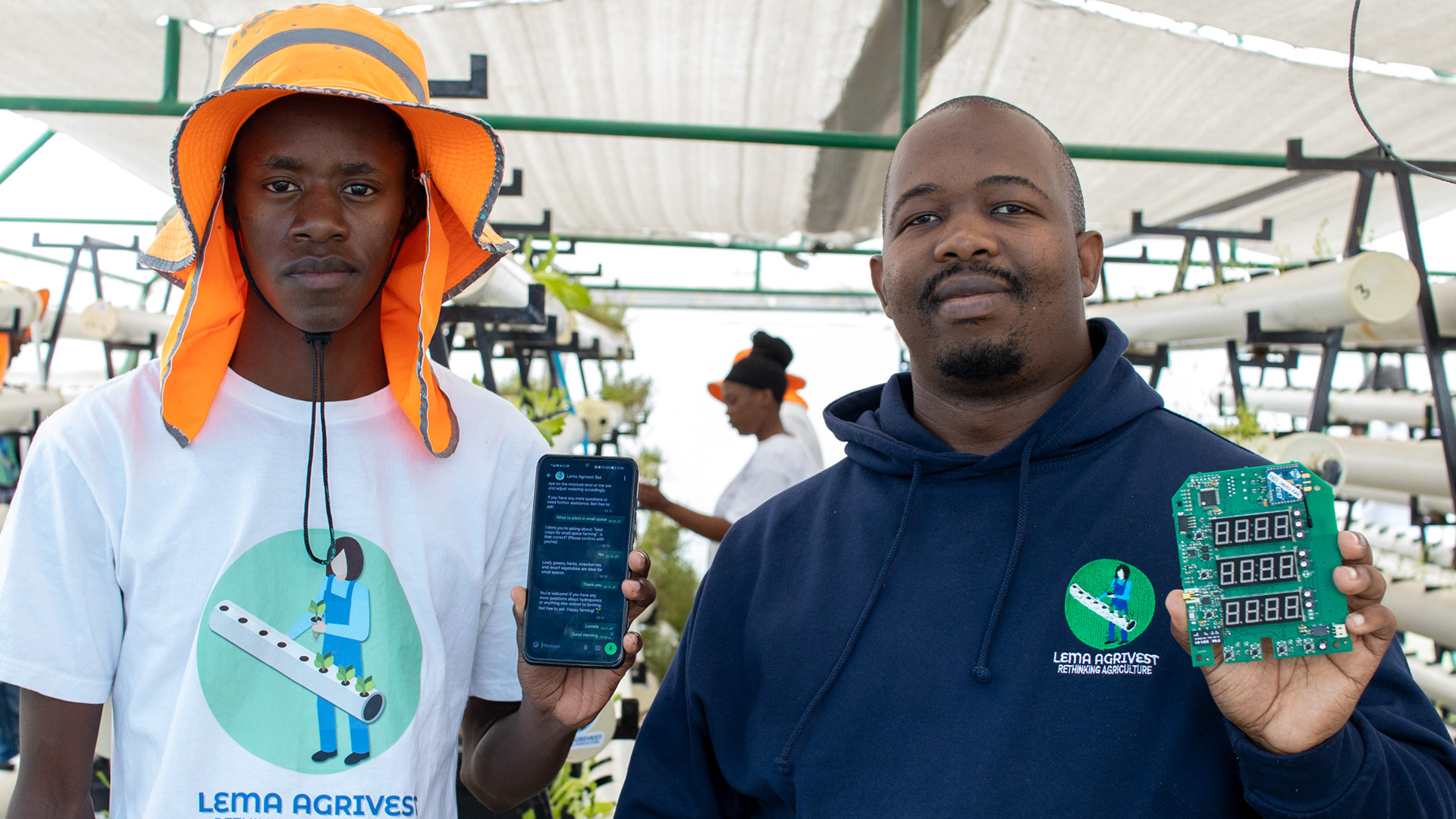
Farmflex integrates smart sensors installed in hydroponic/aquaponic reservoirs to capture key parameters in real time, including pH balance, electrical conductivity, water temperature and humidity. That data feeds into a web-based analytics platform, where AI and machine learning assess conditions, generate recommendations and predict yields, building a dataset to train models. Depending on the setup, the system can either support manual action by the farmer or send signals back for automated adjustments such as nutrient dosing and calibration. To build trust with off-take buyers, Farmflex records parameters into a blockchain-based ledger, creating traceable reporting that helps farmers to demonstrate quality standards and reduce risk across the supply chain.
Crucially, Farmflex is designed around how farmers already communicate. A WhatsApp bot delivers alerts and farm insights without requiring users to log into a new platform and can support photo-based troubleshooting for issues such as pests or diseases, making the system practical in low bandwidth, real world conditions.
Farmflex is delivered by a growing team, combining engineering and field support to install systems, train farmers and provide ongoing monitoring and evaluation - a “handholding” approach that the team sees as central to adoption and long-term success.
Video transcript
We have built Farm Flex, which is an agricultural intelligence layer built for African controlled and smallholder farming. In the long run, this innovation will become a predictive engine for market pricing, credit risk, and yield built on real African farming conditions. Winning Africa Prize will help us build the credibility we need to penetrate South African market, including countries like Angola, Nigeria, Botswana, Zambia and Zimbabwe. And will also help us validate the innovation that it can be ready to penetrate the market and be user ready.
The impact
Farmflex, through Lesponix Collective, has supported more than 160 clients, including four agribusinesses and a cross-border installation in Eswatini. Alongside major reductions in water use, farmers report three to four times higher yields in crops such as lettuce and herbs compared to soil farming, and fewer losses through earlier intervention and improved monitoring.
By replacing guesswork with real-time insight, the platform helps farmers to plan harvest dates, communicate expected volumes and meet buyer standards more consistently.